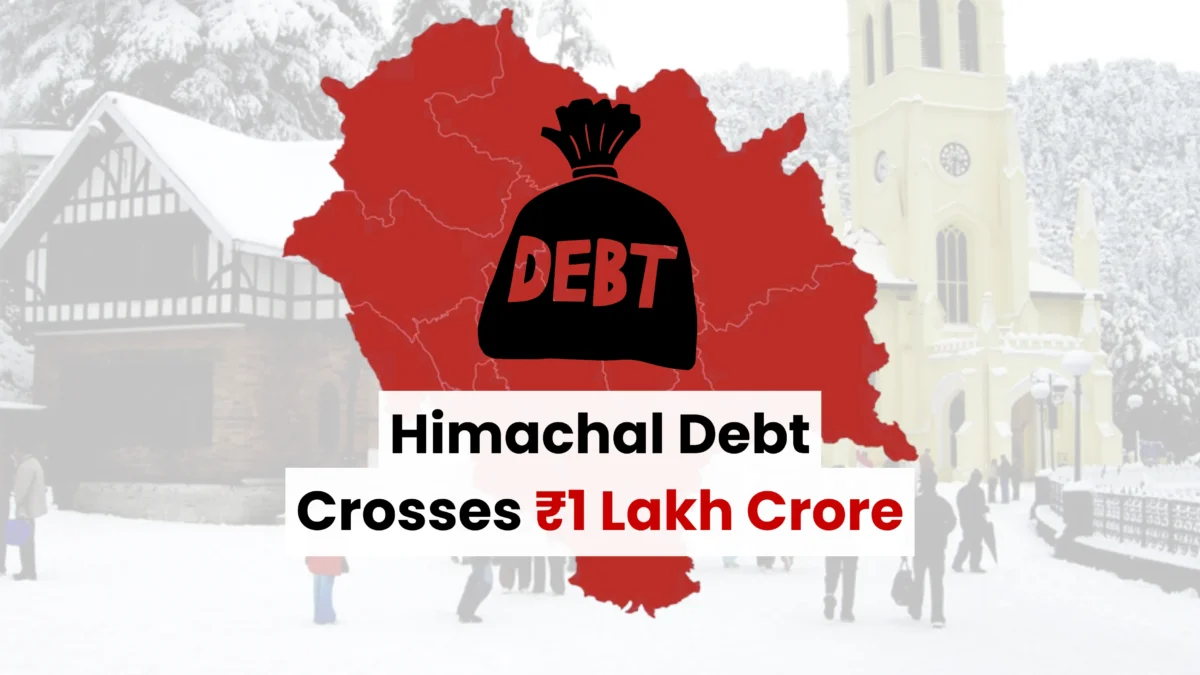
Himachal Pradesh’s public debt has now crossed the ₹1 lakh crore mark, and it’s a number that’s worrying a lot of people across the state. From ordinary citizens to government employees and young people looking for jobs, everyone feels the pressure. The hill state has always faced unique challenges — tough terrain, scattered villages, high cost of building roads and services, and not enough big industries to generate revenue. Let’s walk through how we got here, in clear and simple terms.
The early days after statehood (1971–1990s)
Himachal Pradesh became India’s 18th state on January 25, 1971, following the merger of several hill regions and princely states. In its early years, the state depended heavily on Central financial assistance to bridge developmental gaps.
Revenue Deficit Grants (RDG) under Article 275(1) were a lifeline. This money helped build roads in difficult mountains, open schools and hospitals, set up irrigation, and provide basic services to people living in far-flung areas. Debt existed, but it was manageable. As a percentage of GSDP it sometimes looked high because the state’s economy was small, but in actual rupees, the burden was limited. Most governments in those early decades were Congress-led, and the focus was on steady development with central help.
Debt starts climbing (2000s to 2010s)
Things began changing as the state grew and expectations rose. Both Congress and BJP governments expanded welfare schemes, created more government jobs, improved education and health facilities, and invested in infrastructure.
Here are some key numbers:
- Around 2007: Total outstanding debt was about ₹19,977 crore.
- 2014-15: It had risen to nearly ₹25,729 crore (during Congress rule).
- 2017-18: Debt jumped to around ₹47,906 crore.
Governments kept spending more on development and people-centric programmes, but their own revenue (from taxes, tourism, hydropower etc.) didn’t grow at the same speed. This led to regular revenue deficits — the state was spending more than it was earning year after year. Power sector earnings helped sometimes, but overall, the gap kept widening. Fiscal deficits stayed somewhat under control before COVID but were already showing signs of strain.
Debt during BJP rule (2017–2022)
Debt grew more rapidly in this period. From about ₹47,906 crore in 2017-18, it climbed to nearly ₹76,630 crore by the end of 2022-23 — an average increase of around 12% every year. The total liabilities handed over (including other dues) were close to ₹92,774 crore.
The government received substantial RDG support (nearly ₹55,000 crore over the period), which helped keep things running. But money was also spent on new schemes, institutions, infrastructure pushes, and massive COVID relief. Fiscal deficits widened during these years as expenditure outpaced income.
Debt Crosses ₹1 Lakh Crore Under Current Congress Government (2022–Present)
The present government inherited a difficult situation and has been struggling with it. Debt has continued rising sharply:
- 2022-23: Debt-to-GSDP ratio stood at around 44.3% — already much higher than most states.
- 2025-26 (Revised Estimates): Loan liabilities reached about ₹1.04 lakh crore.
- 2026-27 (Budget Estimates): Projected to go up to nearly ₹1.12 lakh crore.
At the same time, the overall state budget has actually shrunk from around ₹58,514 crore to ₹54,928 crore — something that rarely happens and shows how tight things have become.
Fiscal deficit trends in recent years
- Before COVID, deficits were mostly around 3-4% of GSDP, close to FRBM targets.
- During and right after the pandemic, they shot up, crossing 6% of GSDP in some years due to relief spending and loss of revenue.
- In 2022-23: Fiscal deficit between 4.9% and 6.5%; revenue deficit around 3.2-3.3%.
- 2025-26 (RE): Fiscal deficit around 6.6%.
- 2026-27 Budget: Government is targeting a lower fiscal deficit of ₹9,698 crore (about 3.5% of GSDP) and revenue deficit of ₹6,577 crore (2.4%). This shows an attempt to control the situation.
A major new pressure is the discontinuation of the Revenue Deficit Grant (RDG) of around ₹10,000 crore annually by the 16th Finance Commission. This grant was special support recognising the extra costs of running a hilly state with limited revenue potential. Its removal has created a big hole in the budget and forced the state to borrow even more just to meet regular expenses. RDG had already reduced in recent years, but the full stop has made the crisis sharper.
The repayment trap
One of the most worrying things today is that a huge portion of new loans (around 74%) is now being used just to repay old loans and pay interest. Interest payments alone are expected to cross ₹7,271 crore in 2026-27. Salaries, pensions, and ongoing schemes take up most of the remaining money, leaving very little for new development work.
Why debt kept rising year after year?
There’s no single reason — it’s a mix of long-standing issues:
- Very high cost of building and maintaining roads, schools, and services in mountainous areas.
- Limited industries and a small tax base.
- Growing expenditure on government salaries, pensions, and welfare promises.
- Impact of COVID and repeated natural disasters (cloudbursts, landslides, floods).
- Slow growth in the state’s own revenue despite strong sectors like tourism, hydropower, and horticulture.
- The recent loss of the ₹10,000 crore annual RDG support.
Both Congress and BJP governments over the decades have contributed through popular schemes and expansion of services, but the structural problems of a hill state were never fully solved.
Himachal compare with other states?
Himachal’s total debt amount is not the highest in India (larger states like Maharashtra and Uttar Pradesh have much bigger numbers). But when you look at debt as a percentage of GSDP, Himachal is among the more stressed states:
- Arunachal Pradesh: 53–57% (highest)
- Jammu & Kashmir: Around 51%
- Punjab: 44–47%
- Himachal Pradesh: 39–50%
- Nagaland, West Bengal, Kerala: Also high (36–48%)
- Better performers: Odisha (~13%), Gujarat (15–16%), Maharashtra (18–19%)
Hill and North-Eastern states often show higher ratios because of similar challenges — difficult geography and dependence on central help. Bigger, more industrialised states manage debt better because their economies are larger and generate more revenue.
What lies ahead?
The coming years look difficult. Debt-to-GSDP ratio is moving towards 50%, the budget is shrinking, and repayment burden is heavy. This can mean slower new projects, pressure on government jobs and salaries, and fewer resources for welfare schemes.
On the positive side, Himachal’s economy — especially tourism, services, and horticulture — has shown good growth potential. If the government focuses seriously on increasing its own income, cuts wasteful spending, improves efficiency, and invests wisely in productive areas, the situation can be managed.
Right now, the discontinuation of the ₹10,000 crore RDG is hurting the most. People expect practical solutions rather than blame games — better revenue collection, careful budgeting, and honest long-term planning.
The coming years will show whether Himachal can turn this challenge into an opportunity for stronger and more self-reliant finances. What are your thoughts on this? The state belongs to all of us, and its financial health will decide the future for the next generation.
All figures are taken from official budgets, CAG reports, and reliable sources. They are approximate and can differ slightly between estimates and actual spending. For complete details, check the latest Himachal Pradesh Budget and Economic Survey.