Dropped from the team, stripped of his central contract, and surrounded by criticism—this is how Ishan Kishan engineered one of the most compelling comebacks in Indian cricket with a historic innings against New Zealand in Raipur.
Cricket is not merely a contest of fours and sixes. More often than not, it is a test of belief, patience, and timing. Few recent narratives illustrate this better than the resurgence of Ishan Kishan. Once viewed as a permanent fixture in India’s white-ball plans, Kishan found himself on the outside by the end of 2023. When the BCCI withdrew his central contract, the assumption was swift and unforgiving: the window had closed.
To begin with, the 2024–25 season marked the lowest point of Ishan Kishan’s career. Questions surrounding his absence from domestic cricket triggered official displeasure, which was quickly followed by his removal from the central contract list. Inevitably, public opinion followed suit.
As criticism intensified, Kishan was labelled a “liability,” and his name gradually disappeared from discussions around the 2026 T20 World Cup. For a player once celebrated for his fearlessness at the top of the order, the fall was both sudden and severe.
Domestic grind that revived Ishan Kishan
Yet, instead of engaging with the criticism, Ishan Kishan made a deliberate choice: let performances speak. Consequently, he returned to the domestic circuit, assumed leadership responsibilities with Jharkhand, and committed himself to consistent output.
That decision soon paid dividends. In the Syed Mushtaq Ali Trophy, Kishan amassed 517 runs and, more importantly, led Jharkhand to their maiden title. Gradually, the conversation began to shift. Those runs were not just numbers on a scorecard; they were reminders of unfinished business.
Also read: 10 lesser-known facts about former CM Jai Ram Thakur on his birthday
Raipur match changed the narrative
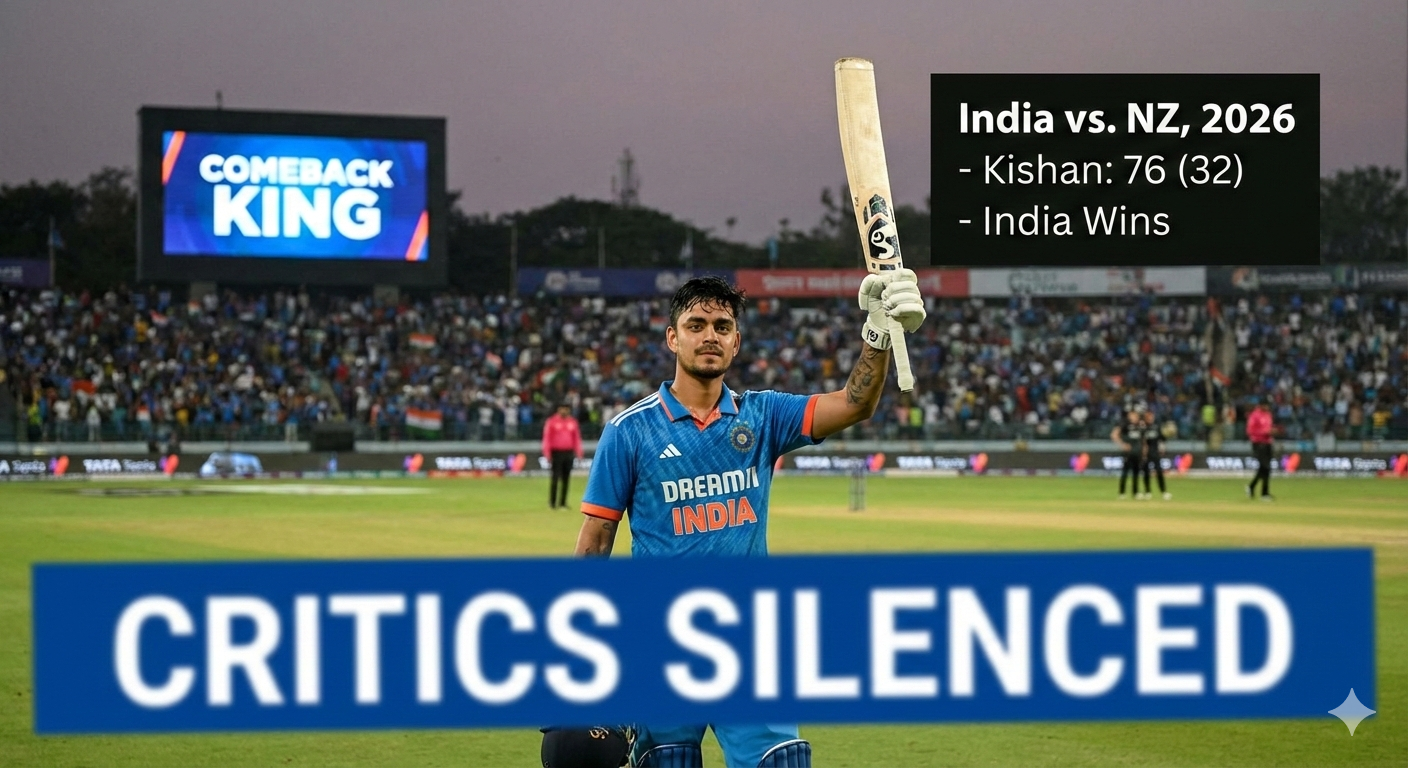
Against this backdrop, the stage was set on 23 January 2026 at the Shaheed Veer Narayan Singh Stadium in Raipur. New Zealand’s 208-run target presented a steep challenge, and the margin for error was minimal. Nevertheless, Ishan Kishan walked in with clarity and purpose.
From the outset, his intent was unmistakable. He dismantled the bowling attack with controlled aggression, reaching his half-century in just 21 balls. Eventually, he finished with 76 off 32 deliveries, striking 11 fours and four sixes.
Meanwhile, his partnership with Suryakumar Yadav ensured momentum never dipped. As a result, India completed the fastest successful chase of a 200-plus target in T20 cricket history—a record that underscored the scale of the performance.
Importantly, what followed the innings was as telling as the knock itself. When tears welled up in Ishan Kishan’s eyes, they reflected more than joy. They spoke of isolation, persistence, and the emotional toll of fighting doubt over two difficult years.
Unsurprisingly, the reaction was immediate. Those who had questioned Kishan’s place were forced to reassess. Captain Suryakumar Yadav publicly backed him at No. 3, identifying Ishan Kishan as a key component of India’s T20 structure.
Moreover, his ability to attack from the first ball adds a distinct dimension to India’s batting order—one that could prove decisive in the lead-up to the 2026 T20 World Cup.
The story of Ishan Kishan is no longer about exclusion or controversy. Instead, it is about response—measured, disciplined, and emphatic. His Raipur innings did not erase the past, but it firmly redefined the present.
The question, therefore, has shifted. It is no longer about whether Ishan Kishan belongs at this level. The real challenge now lies with opposition bowlers: figuring out how to contain him.
Read more stories on Kangra Ki Awaaz